
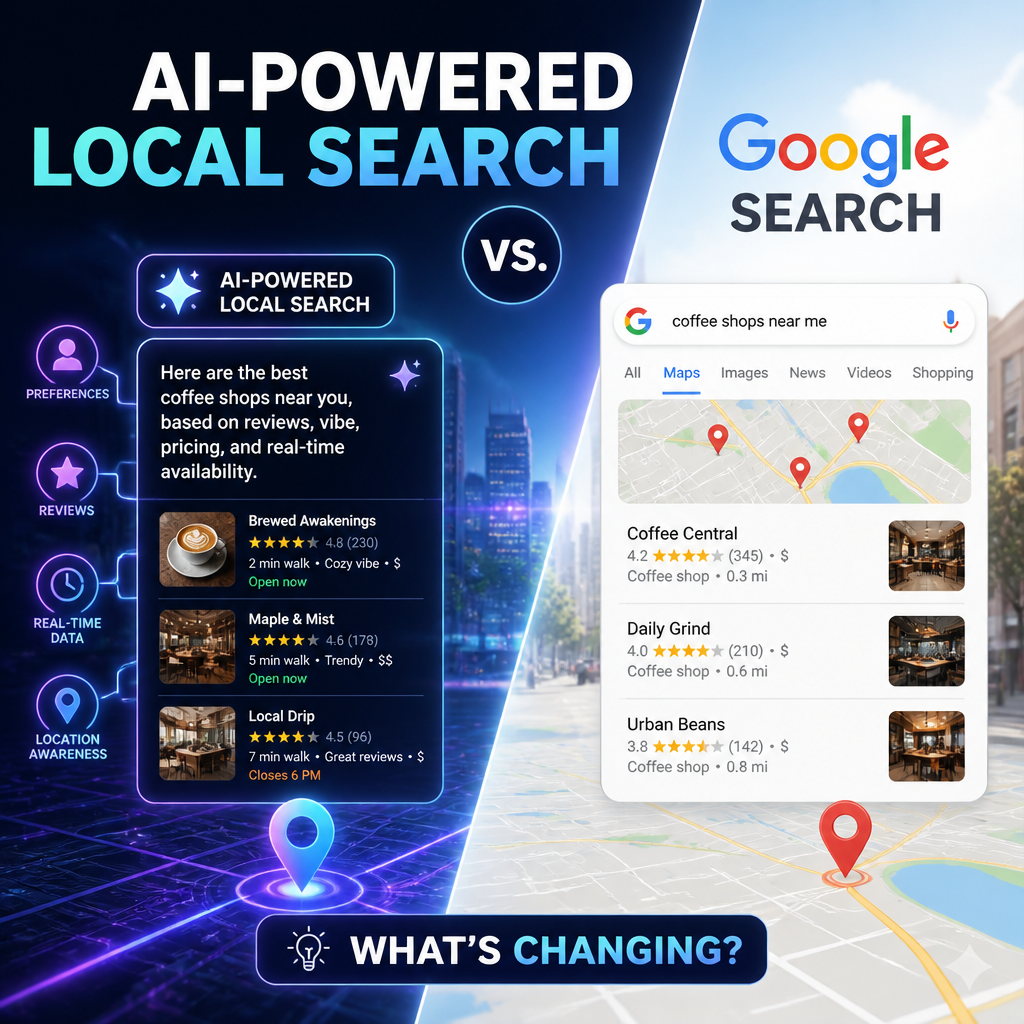
AI-Powered Local Search vs. Google Search: What’s Changing?
AI-Powered Local Search vs. Google Search: What’s Changing?
For years, finding a nearby restaurant, plumber, or pharmacy meant typing a few words into Google and scanning a list of links and map results. That familiar process is beginning to change. AI-powered local search can interpret more detailed questions, summarize options, and tailor recommendations to a person’s needs.
This doesn’t mean Google Search is disappearing. Instead, search is becoming more conversational and more focused on giving people a useful answer—not just a page of results. Here’s what’s changing and what it means for local businesses and customers.

How Traditional Google Search Works
A conventional Google search generally starts with a query such as “coffee shop near me.” Google uses signals including the searcher’s location, business information, reviews, and relevance to display local results.
For many location-based searches, those results include a map and a list of businesses. People can compare ratings, opening hours, distance, photos, and websites before making a choice.

This model is useful because it gives people several options and lets them decide which information to trust. But it can require extra work: opening different listings, reading reviews, and checking details across multiple websites.
What AI-Powered Local Search Adds
AI-powered local search changes the experience by letting people describe what they want in everyday language. Rather than searching for “Italian restaurant,” someone might ask, “Where can I get a quiet Italian dinner near downtown that has vegetarian options?”

AI tools can interpret the different parts of that request and produce a synthesized response. Depending on the platform and available data, that response may include suggested businesses, relevant details, and links to sources.
The shift is from matching keywords to understanding intent. AI may also handle follow-up questions, such as asking whether a suggested restaurant has outdoor seating or is open late. Instead of starting over with a new search, users can refine the conversation.
Key Differences at a Glance
- Traditional search usually presents a ranked set of links, listings, or map results.
- AI-powered search may summarize information and recommend a smaller number of options.
- Traditional search often depends on users comparing sources themselves.
- AI-powered search can make that comparison faster, although the summary may not include every relevant detail.
- Both approaches rely on accessible, accurate information about businesses and their services.
AI search is not a single product or format. Google, other search platforms, map services, and standalone AI assistants may all present local results differently. The experience can also vary by location, device, query, and the information available online.
What’s Changing for Local Businesses?
The growing role of AI makes clear, consistent business information more important. AI systems need reliable details to understand what a business offers and when it is available. If a restaurant’s hours differ across its website and directory listings, for example, a search tool may surface confusing or outdated information.
Local businesses can strengthen their online presence by keeping core details accurate:
- Business name, address, phone number, and opening hours
- Services, products, and service areas
- Current photos and a well-maintained website
- Helpful answers to common customer questions
- Recent, genuine customer reviews
A polished website and complete business profile still matter. So do useful pages that explain services in plain language. These can help both people and search systems understand whether a business fits a particular need.
The Limits of AI Recommendations
AI-generated answers can save time, but they are not guaranteed to be complete or current. A summary might overlook a new service, misinterpret a review, or draw on information that has not been updated. For important details—such as availability, pricing, accessibility, or health-related services—customers should confirm directly with the business.
There is also a visibility trade-off. A list of search results gives users multiple businesses to explore, while a concise AI response may emphasize only a few recommendations. That can make accuracy and a strong reputation even more valuable, while making it harder for less-established businesses to be noticed.
How to Adapt Without Chasing Every Trend
Local businesses don’t need to rebuild their marketing strategy around AI alone. The fundamentals remain practical and familiar: provide accurate information, explain services clearly, earn trust, and make it easy for customers to get in touch.
Think about the questions customers actually ask. If people frequently want to know whether you offer same-day appointments, accept walk-ins, or serve a particular neighborhood, answer those questions on your website and business profiles. Clear information is useful whether a customer finds it through Google Search, a map listing, or an AI-powered assistant.
A Search Experience in Transition
The difference between AI-powered local search and Google Search is less a contest between old and new than a change in how information is presented. Traditional search gives people a broad set of options to investigate. AI can help narrow those options and answer more specific questions in a conversational way.
For users, the best approach is to treat AI recommendations as a helpful starting point and verify important details. For local businesses, the priority is to keep online information accurate, relevant, and easy to understand. As search evolves, those basics will remain valuable across platforms.