
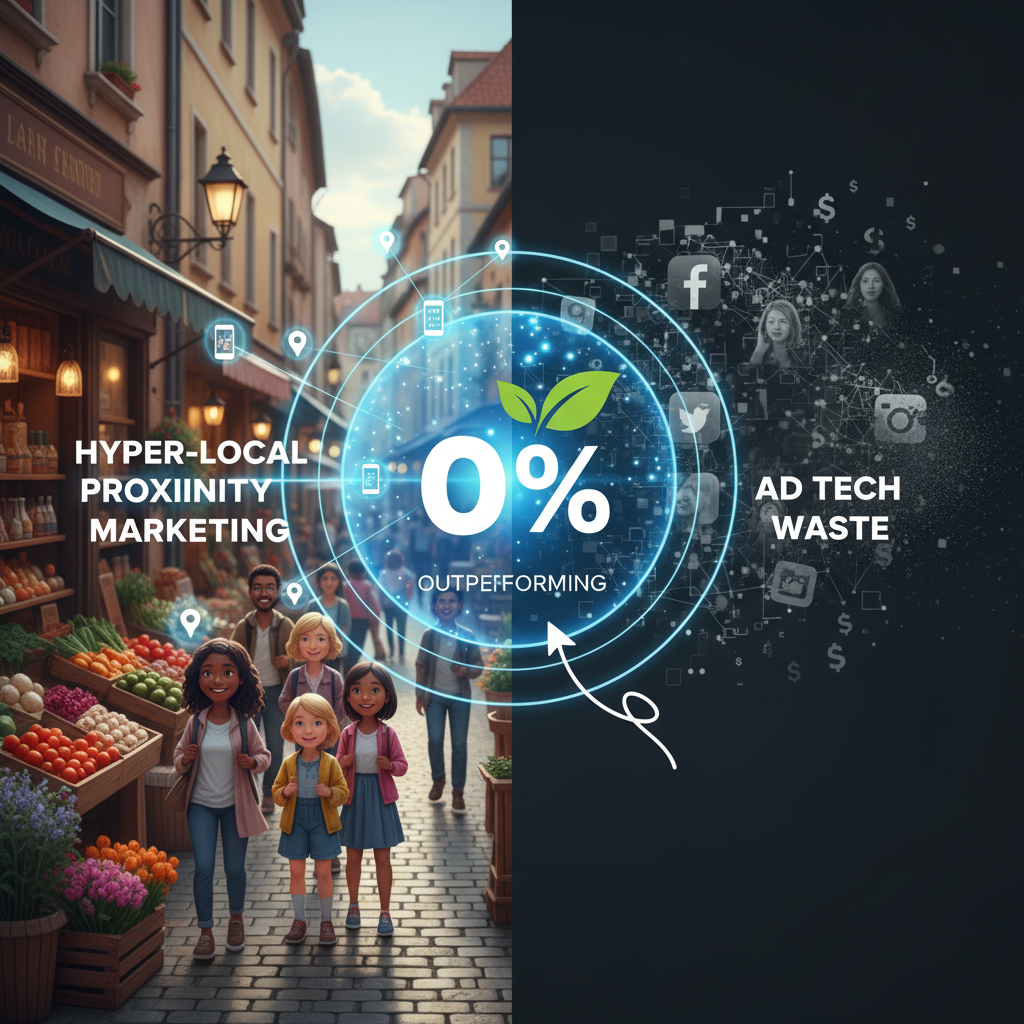
0% Ad Tech Waste: Why Hyper-Local Proximity Marketing is Outperforming Social Ads
Digital advertising often asks businesses to pay for attention before confirming whether that attention is locally relevant. Hyper-local proximity marketing approaches the challenge differently: it helps businesses become discoverable when nearby people are actively looking for a place, product, service, event, or specialist. The idea behind “0% ad tech waste” is not a literal guarantee. It is a practical goal—reducing irrelevant exposure by prioritizing local intent, geographic relevance, and timely discovery.
What Hyper-Local Proximity Marketing Means
Proximity Marketing connects a business with potential customers based on how close they are to a particular location or service area. Instead of targeting a broad audience across a city, state, or country, a business can focus on people who are realistically close enough to visit, call, book, or request help.

Hyper-Local Marketing narrows that focus further. It may center on a neighborhood, commercial district, walking radius, ZIP code, or small service area. For a restaurant, proximity could mean people searching within a few blocks. For a plumber or mobile pet groomer, it could mean households within a practical driving range.
The purpose is not simply to reach fewer people. It is to improve the connection between what someone needs, where that person is, and what a nearby business can provide.

Local Intent Makes Proximity Valuable
Local intent appears when a person wants an answer tied to a specific place. Searches such as “coffee near me,” “same-day tire repair,” or “family activities nearby” indicate more than general curiosity. The person may be preparing to make a decision in the near future.
This is why Local Search can be so valuable. A person does not always begin with the name of a business. Instead, the search often begins with a need. Businesses that clearly describe their services, location, availability, and relevant local context are better positioned to appear during that discovery process.

Consider a bakery located at 1015 Main Street. Showing its message to people hundreds of miles away creates awareness but little immediate opportunity. Making the bakery discoverable to nearby people searching for fresh bread, breakfast, catering, or a place to meet aligns visibility with realistic customer intent.
Relevance Is More Than Distance
Being nearby does not automatically make a business the right match. Effective proximity marketing combines distance with context. A useful local result should reflect several factors:
- The product, service, or experience the person wants
- The business’s actual location or service area
- Accurate hours and current availability
- Relevant categories and descriptive information
- The customer’s preferred travel distance
- Whether the business can satisfy the request
For example, a nearby restaurant may be geographically relevant but unsuitable for someone looking for vegan catering. A contractor may serve the right neighborhood but not offer the requested type of repair. Strong local discovery depends on matching intent and capability, not simply ranking the closest option first.
How AI-Powered Search Supports Discovery
AI-powered search can help interpret conversational requests that are more detailed than traditional keyword queries. Someone might ask for “a quiet café within walking distance that is suitable for a morning meeting” or “a local specialist who can help with an urgent home repair.” These requests contain multiple signals, including purpose, distance, timing, and preferences.
Platforms focused on local discovery can organize those signals into more useful results. NearAIx, for example, presents itself as a local proximity guide designed to help people discover nearby places, events, deals, groups, and specialists. Its relevance to this conversation lies in its focus on connecting local needs with nearby options rather than treating discovery as a purely global search experience.
How This Differs From Broad Social Advertising
Social advertising and hyper-local discovery serve different purposes. Social platforms can be useful for building recognition, telling a visual story, introducing a new product, and maintaining engagement with an audience. They can also support geographic targeting, making them valuable components of many local campaigns.
However, social ads often reach people while they are browsing content rather than actively searching for a local solution. Even when an audience matches selected interests or demographics, not every viewer has an immediate need. This can create a gap between audience fit and purchase intent.
Proximity-based discovery usually operates closer to the moment of need. The customer may already be searching for somewhere to go or someone to contact. That does not mean proximity marketing will always outperform social advertising. Results depend on the business, market, customer journey, data quality, creative execution, and campaign objective.
Choosing the Right Channel for the Objective
A balanced strategy recognizes the strengths of both approaches:
- Social advertising can introduce a business and build familiarity before a need arises.
- Local discovery can help the business appear when a nearby customer expresses intent.
- Proximity Marketing can emphasize practical distance and service-area relevance.
- Organic local content can answer neighborhood-specific questions and build trust.
Businesses do not necessarily need to abandon social media. A better approach may be to use social channels for awareness while strengthening local search visibility for discovery and action.
Reducing Ad Tech Waste Without Making Guarantees
The phrase “0% ad tech waste” should be understood as a strategic direction, not a measurable promise that every impression or interaction will produce value. No marketing channel can eliminate uncertainty. People compare options, change plans, browse casually, or decide not to buy.
Businesses can still reduce avoidable waste by keeping local information accurate, defining realistic service areas, using specific categories, publishing useful location-based content, and making the next step clear. A complete profile, understandable offer, accurate address, and simple contact path can make local discovery more effective.
Ultimately, hyper-local proximity marketing shifts the central question from “How many people can we reach?” to “How easily can the right nearby person find us?” That change places local intent, relevance, proximity, and discovery at the center of the strategy. For businesses that depend on customers in a defined area, those factors can make marketing more focused while complementing the broader reach and storytelling strengths of social advertising.