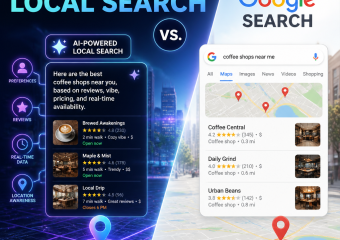
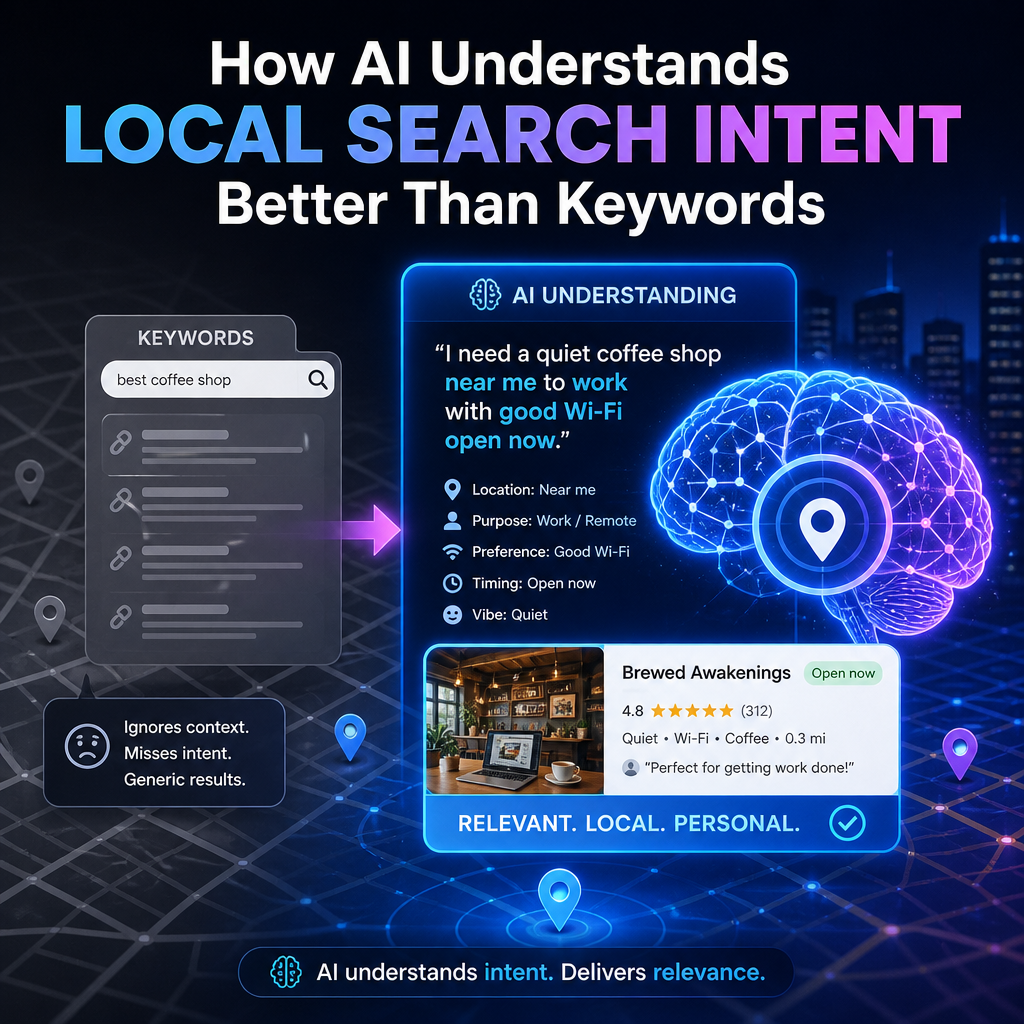
How AI Understands Local Search Intent Better Than Keywords
How AI Understands Local Intent Better Than Keywords
A search for “best coffee” can mean very different things depending on who is searching and where. Someone in downtown Chicago may be looking for a nearby café to visit now. Someone else may want recommendations for a future trip—or simply be researching coffee blends.
Traditional keyword matching sees the words. AI-powered search can consider more of the context behind them. That shift helps search engines recognize local intent: the likelihood that a person wants information, products, or services connected to a particular place.

Understanding this change matters for businesses that rely on nearby customers. Local visibility is no longer just about repeating a city name or adding “near me” to a page. It is about clearly communicating what a business offers, where it operates, and how it meets local needs.
From Matching Words to Interpreting Meaning
Keywords still matter, but they are only one part of a search. AI systems can analyze how words relate to one another and interpret a query as a complete request.

For instance, “emergency plumber open now” signals several things at once:
- The searcher needs a plumbing service.
- The need is urgent.
- The person wants a provider that is currently available.
- Proximity is likely important.
A page that mentions plumbing frequently but provides no service area, contact details, or opening hours may be less useful than a clear, complete business profile. AI can use connected signals to help identify which results best fit the request.

Context Gives Short Queries More Meaning
People often search in fragments rather than full sentences. They might type “dentist Saturday,” “vegan lunch,” or “bike repair.” On their own, these phrases leave questions unanswered. Is the person looking for a nearby option? Do they need a specific service? Are they ready to visit today?
Search systems can draw on contextual clues, including the searcher’s approximate location, the wording of the query, and information about available businesses. The same phrase may therefore produce different results in different places or at different times.
Local Intent Is More Than “Near Me”
The phrase “near me” makes local intent obvious, but people do not always use it. A search for “roof repair after hail” may indicate a local need even without a city name. A search for “family lawyer in Austin” names a location directly. A query like “where can I get keys copied?” may depend on the searcher’s current area.
AI can help connect these different forms of language to relevant local results. It can also distinguish between businesses that offer similar services but serve different neighborhoods, hours, or customer needs.
This does not mean AI knows exactly what every searcher wants. Location data may be imprecise, and a query can have more than one interpretation. But using a wider range of signals can help search systems make a more informed match than literal keyword overlap alone.
What Businesses Can Do to Support Local Search
Businesses cannot control how search systems interpret every query. They can, however, make their information clear and consistent so that both people and search engines can understand it.
Describe Services and Service Areas Clearly
Use natural language to explain what the business does and where it serves customers. A home-services company, for example, should identify the specific services it offers and the towns or neighborhoods it covers. Avoid creating thin pages that differ only by swapping in place names.
Keep Business Details Consistent
Check that the business name, address, phone number, website, and hours are accurate across the website and key business listings. Update special hours and temporary closures promptly. Conflicting information can confuse potential customers and make it harder to assess which details are reliable.
Add Useful, Specific Information
Answer the questions customers are likely to have before they visit or call. Include details such as appointment requirements, parking, accessibility, delivery areas, accepted payment methods, and emergency availability where relevant.
Reviews can also help people understand the experience a business provides. Encourage honest feedback, and respond professionally. The goal is not to insert keywords into reviews, but to build a trustworthy picture of the business.
Write for People, Not Search Tricks
AI’s ability to interpret local intent makes clear communication more valuable than keyword repetition. A page that naturally explains a service, its location, and what customers can expect is more useful than one built around awkward phrases such as “best plumber near me.”
Local SEO still benefits from relevant terms, accurate listings, and a well-organized website. But these elements work best when they reflect the real business. By providing specific, current, and helpful information, businesses give search systems stronger context—and give local customers better reasons to choose them.