
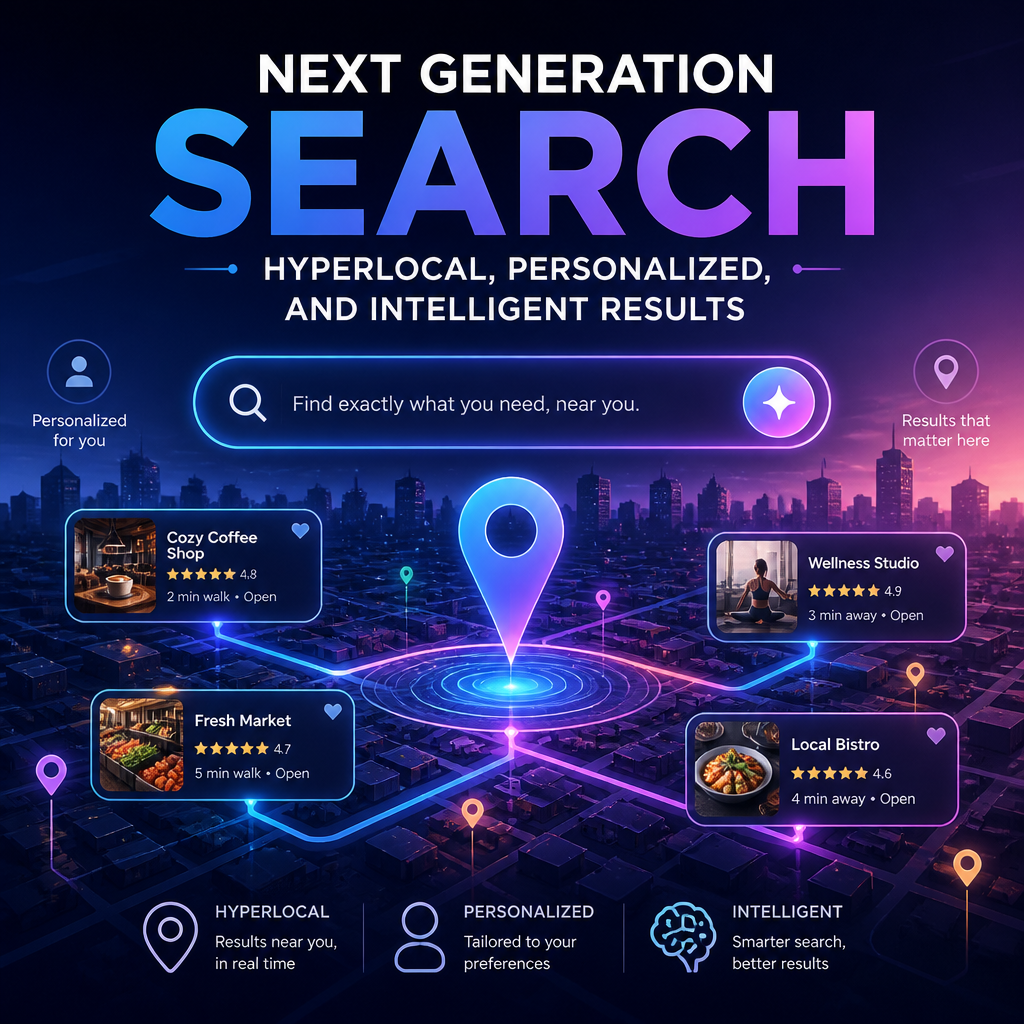
Next Generation Search: Hyperlocal, Personalized, and Intelligent Results
The Next Generation of Search: Hyperlocal, Personalized, and Intelligent
Search is changing from a tool that simply retrieves information into an experience that anticipates what people need. Instead of presenting the same list of links to everyone, modern search systems increasingly consider where a person is, what they are trying to do, and which answers are most useful in the moment.
This shift is shaping the next generation of search: hyperlocal, personalized, and intelligent. Together, these qualities are making discovery faster and more relevant—while raising important questions about privacy, accuracy, and trust.

Search That Understands Where You Are
Hyperlocal search focuses on a person’s immediate area, sometimes down to a specific neighborhood or street. A search for “coffee shop” can now surface nearby cafés, display opening hours, show how busy they are, and offer directions without requiring a detailed location query.
This is useful because many searches are tied to a place and a moment. People look for a pharmacy that is open now, a repair service nearby, or a restaurant within walking distance. More precise location data helps search tools provide practical answers instead of broad suggestions.

For local businesses, this also changes how visibility works. A company may need to focus not only on general search rankings but on the details that help nearby customers choose it, such as:
- Accurate business hours and contact information
- Recent reviews and clear responses to feedback
- Helpful descriptions of services and service areas
- Updated photos, menus, and availability
The best local results are not necessarily the businesses with the largest advertising budget. They are often the ones that provide reliable, relevant information when a nearby customer needs it.

More Personal, More Relevant
Personalized search uses signals such as past activity, language preferences, device type, and expressed interests to tailor results. Someone researching hiking trails may see outdoor destinations and gear recommendations, while another person making the same search may receive accessible routes or family-friendly options.
Personalization can reduce effort. People do not always know the exact words to use, and search systems can use context to interpret what they mean. A search for “weather before my run” may be understood as a request for local conditions over a particular time window rather than a general forecast.
However, personalization works best when it remains helpful and transparent. If results are shaped too heavily by previous behavior, people may see fewer unfamiliar perspectives or discover less beyond their usual interests. Users should have meaningful ways to review or control the data that influences their results.
Intelligent Search Goes Beyond Keywords
Artificial intelligence is helping search tools understand questions in more natural language. Instead of matching a few words to web pages, systems can interpret intent, connect related ideas, and summarize information from multiple sources.
That makes it easier to ask complex questions, such as “What are some quiet places to work near the station that stay open after six?” An intelligent search experience can combine location, opening hours, atmosphere, and proximity to identify useful options.
These systems can also support follow-up questions. A person might ask for a list of nearby parks, then narrow it to places with accessible paths or public restrooms. Search becomes more like a conversation, with each response building on the previous one.
Still, fluent answers are not always accurate answers. AI-generated summaries can omit important qualifications, rely on outdated information, or present uncertain claims with confidence. For high-stakes topics—such as health, finance, or legal matters—people should check authoritative sources and look beyond a short summary.
Balancing Convenience and Trust
The next generation of search will depend on more than sophisticated technology. People need to understand why certain results appear and feel confident that those results are useful rather than simply persuasive.
A trustworthy search experience should prioritize:
- Accuracy: Information should be current, attributed, and corrected when necessary.
- Transparency: Users should be able to distinguish sponsored content from organic results and see where answers come from.
- Privacy: Location and personal data should be collected and used responsibly.
- Choice: People should have options to adjust personalization and explore a wider range of results.
These principles matter to businesses, too. Strong visibility increasingly comes from being genuinely helpful: publishing clear information, demonstrating expertise, and maintaining accurate details across platforms.
A More Useful Way to Find Answers
Hyperlocal, personalized, and intelligent search can make information feel closer and easier to use. It can help someone find the right service around the corner, uncover options that suit their needs, or ask a complicated question in ordinary language.
The challenge is to make these experiences both convenient and dependable. As search evolves, the most valuable systems will not merely predict what people want. They will help people make informed choices, show how their answers were produced, and give users control over the experience.