
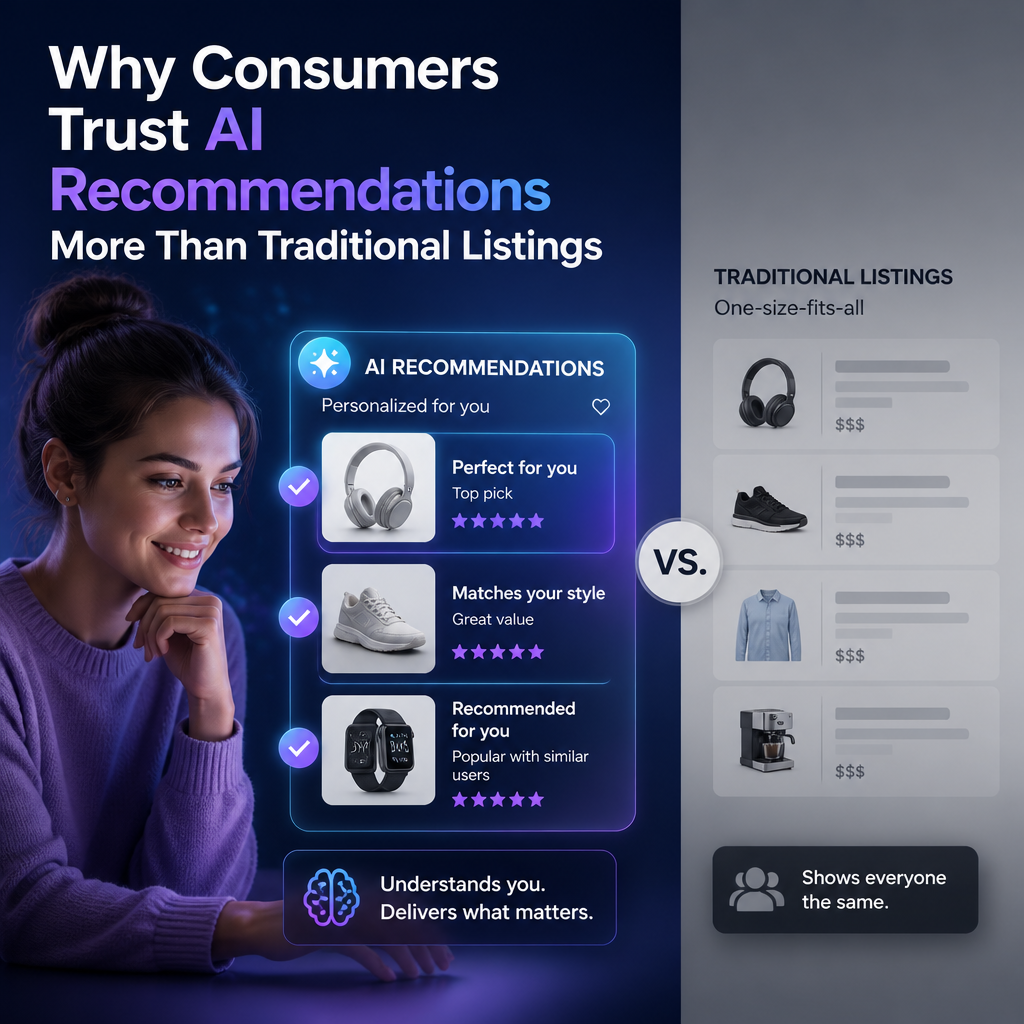
Why Consumers Trust AI Recommendations More Than Traditional Listings
Why Consumers Trust AI Recommendations More Than Traditional Listings
For years, consumers have relied on directories, search results, and product listings to decide what to buy or where to go. These traditional options still matter, but they often leave people with a long list of choices and little help comparing them. AI recommendations offer a different experience: they can narrow the options, explain why a choice may fit, and adapt to what a person says they need.
That convenience is changing how people discover products and services. Consumers may trust AI recommendations more than traditional listings not because they assume every suggestion is perfect, but because the process can feel more personal, relevant, and transparent.

Personalization Makes Choices Feel More Relevant
Traditional listings tend to show the same results to many users. A directory might sort businesses alphabetically, while a shopping site may rank products by popularity or advertising spend. These methods can be useful, but they may not reflect an individual’s budget, preferences, or circumstances.
AI tools can take those details into account. A shopper can describe a need in everyday language—such as finding a quiet laptop for travel under a certain price—and receive a shorter, more targeted set of options.

This level of personalization reduces the effort required to search. Instead of opening dozens of listings, comparing specifications, and guessing which details matter, consumers can start with recommendations tailored to their priorities.
Recommendations Can Explain the Reasoning
A list of results does not always make clear why one option appears above another. Consumers may wonder whether a listing is prominent because it is genuinely suitable, widely popular, or paid for through advertising.

AI recommendations can help by summarizing the factors behind a suggestion. A tool might explain that a product was selected for its price, size, customer ratings, or compatibility with a stated requirement. Even a brief explanation can make a recommendation easier to evaluate than a bare link or ranking.
This does not mean every AI system reveals how it works. Some recommendations are still shaped by commercial partnerships, incomplete data, or opaque ranking rules. Trust is strongest when a system makes its criteria clear and distinguishes useful guidance from sponsored promotion.
Conversational Search Feels Easier
Traditional search usually depends on choosing the right keywords. If consumers do not know the technical terms for a product or service, they may struggle to find relevant results. AI interfaces allow people to ask questions more naturally and refine them through follow-up prompts.
A user might begin with, “I need a beginner camera,” then add, “I mostly take travel photos,” or “I want something lightweight.” The conversation helps narrow the search without requiring the person to start over each time.
This back-and-forth can feel more supportive than navigating filters and category menus. It also helps consumers discover what questions to ask, especially when they are unfamiliar with a market.
Summaries Save Time and Reduce Overload
Online listings often contain a mixture of specifications, reviews, promotional claims, and technical details. Comparing everything can become tiring, particularly when there are many similar options.
AI can organize that information into a concise overview. It may highlight common praise and complaints, compare key features, or identify trade-offs between two choices. Rather than reading every review, a consumer can get an initial sense of what matters and investigate further.
The value is not simply faster decision-making. A clear summary can make a complicated choice feel manageable, helping people focus on the details that match their needs.
Trust Still Depends on Accuracy and Transparency
Convenient recommendations are not automatically reliable. AI can misunderstand a request, rely on outdated information, or present an inaccurate summary with confidence. It may also reflect bias in the data it uses or favor options that are commercially advantageous to the platform.
Consumers are more likely to trust recommendations when they can:
- See why an option was suggested
- Check current prices, availability, and product details
- Compare recommendations with independent reviews
- Identify sponsored results or commercial relationships
- Correct the system when it misunderstands a preference
These safeguards matter because trust should come from useful evidence, not just a polished conversational experience.
A New Starting Point for Decision-Making
AI recommendations are gaining trust because they address familiar frustrations: too many choices, unclear rankings, and time-consuming comparisons. By tailoring results, explaining trade-offs, and responding to follow-up questions, AI can make discovery feel more direct than browsing traditional listings.
Still, recommendations work best as a starting point rather than a substitute for judgment. Consumers benefit most when AI helps them find and compare relevant options while leaving them in control of the final decision. When personalization is paired with transparency and verification, AI recommendations can become a practical, trustworthy part of everyday shopping.