
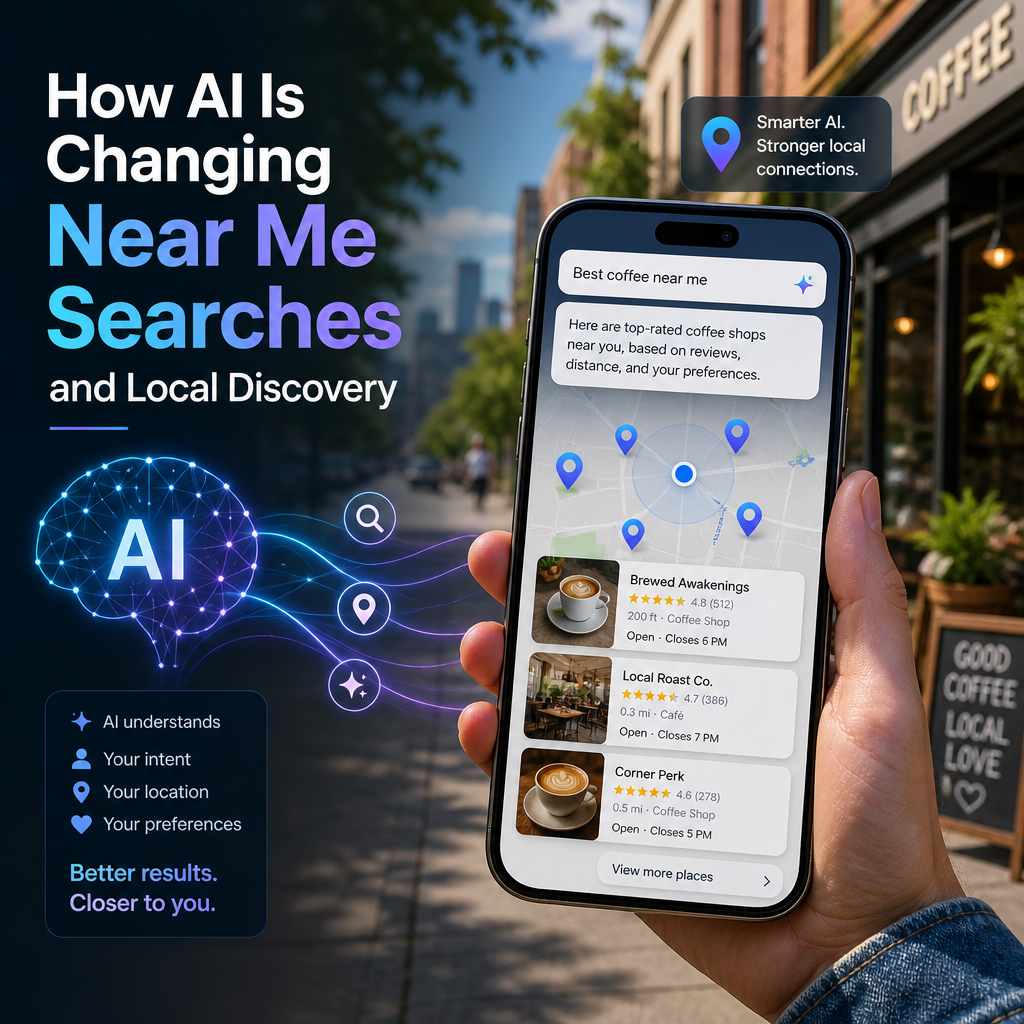
How AI Is Changing Near Me Searches and Local Discovery
Near Me Searches Are Evolving: What AI Means for Local Discovery
For years, a “near me” search meant typing a phrase such as “coffee shop near me” or “plumber near me” and choosing from a list of nearby businesses. That familiar search is changing. AI is helping search tools interpret more detailed questions, compare local options, and present recommendations in a more conversational way.
For people looking for a nearby service, this can make discovery feel faster and more personal. For local businesses, it means that visibility depends on more than appearing on a map. Clear, accurate information and a trustworthy online presence matter more than ever.

From Keywords to Everyday Questions
Traditional local searches often relied on short phrases. People might search for “dentist near me” and then open several listings to compare location, hours, and reviews.
AI-powered search can respond to questions that contain more context, such as:

- “Where can I find a dentist that takes new patients this week?”
- “What’s a quiet café nearby with outdoor seating?”
- “Is there a hardware store open late near me?”
Instead of matching only a few keywords, AI tools can try to understand what the person wants and which details matter. The results may take the form of a summary, a shortlist, or a conversational answer that draws on business listings, websites, reviews, and other available information.
That doesn’t make location or relevance less important. It changes how those factors are combined with details such as opening hours, services, accessibility, and customer feedback.

What AI Changes for Local Discovery
More context in the results
A search for “near me” is no longer always just about distance. A person may want the closest option, but they may also care about price, availability, atmosphere, or a specific service.
AI can help connect those preferences to local information. Someone searching for a family-friendly restaurant, for example, may see suggestions that mention seating, menu options, or customer comments. The quality of that answer depends on whether useful, reliable information is available in the first place.
Less browsing between websites
Searchers have traditionally compared several listings and websites on their own. AI-generated summaries may bring some of that information together before a person clicks through.
This can make decisions more convenient, but it also means businesses need to consider how they appear in the summary—not just whether they rank in a list. Accurate details, consistent descriptions, and helpful website content can make it easier for search tools to represent a business correctly.
More natural, conversational searches
People can ask follow-up questions rather than starting over with a new search. They might ask for a nearby option, then narrow it down by opening hours or a particular feature.
For local businesses, this reinforces the value of describing offerings in clear, everyday language. A vague description may not answer a detailed question. A specific description of services, location, and practical details is more useful to both potential customers and search systems.
How Local Businesses Can Adapt
AI is changing the way local results are presented, but many fundamentals remain the same. Businesses can take practical steps to make their information easier to find and understand:
- Keep business details accurate. Check your name, address, phone number, hours, and service areas across your website and business listings.
- Explain what you offer clearly. Use specific descriptions of products, services, and specialties instead of relying on broad promotional language.
- Make important details easy to find. Include information such as appointment options, accessibility, parking, payment methods, and current hours when relevant.
- Maintain a useful website. Organize pages around customer needs and make sure they work well on mobile devices.
- Encourage honest reviews. Genuine customer feedback helps people assess a business and can provide useful context about the experience.
- Update information when things change. Seasonal hours, new services, temporary closures, and changes in availability should be reflected promptly.
These steps don’t guarantee a particular position or AI recommendation. They do help reduce confusion and give search tools and customers a clearer picture of the business.
Trust Still Matters
AI can organize information, but it can also make mistakes or present outdated details. Searchers should check important information directly with a business, especially when timing, pricing, or availability is critical.
Businesses, meanwhile, should monitor how their information appears across search platforms and correct errors where possible. A polished AI summary cannot replace a consistent, trustworthy customer experience.
The Future of “Near Me” Searches
Near me searches are becoming more conversational and more closely tied to individual needs. People may soon expect local discovery tools to understand not only where they are, but what they need and which details will help them choose.
For local businesses, the goal is not to write for an algorithm at the expense of real customers. It is to provide accurate, specific, and useful information wherever people search. As AI reshapes local discovery, businesses that make their value easy to understand will be better positioned to earn attention—and trust.